Does Your First-in-Human Study Need to Start in the United States?
April 2026
Does Your First-in-Human Study Need to Start in the United States?
The FDA IND process used to be a gateway. For many biotechs today, it has become a bottleneck.
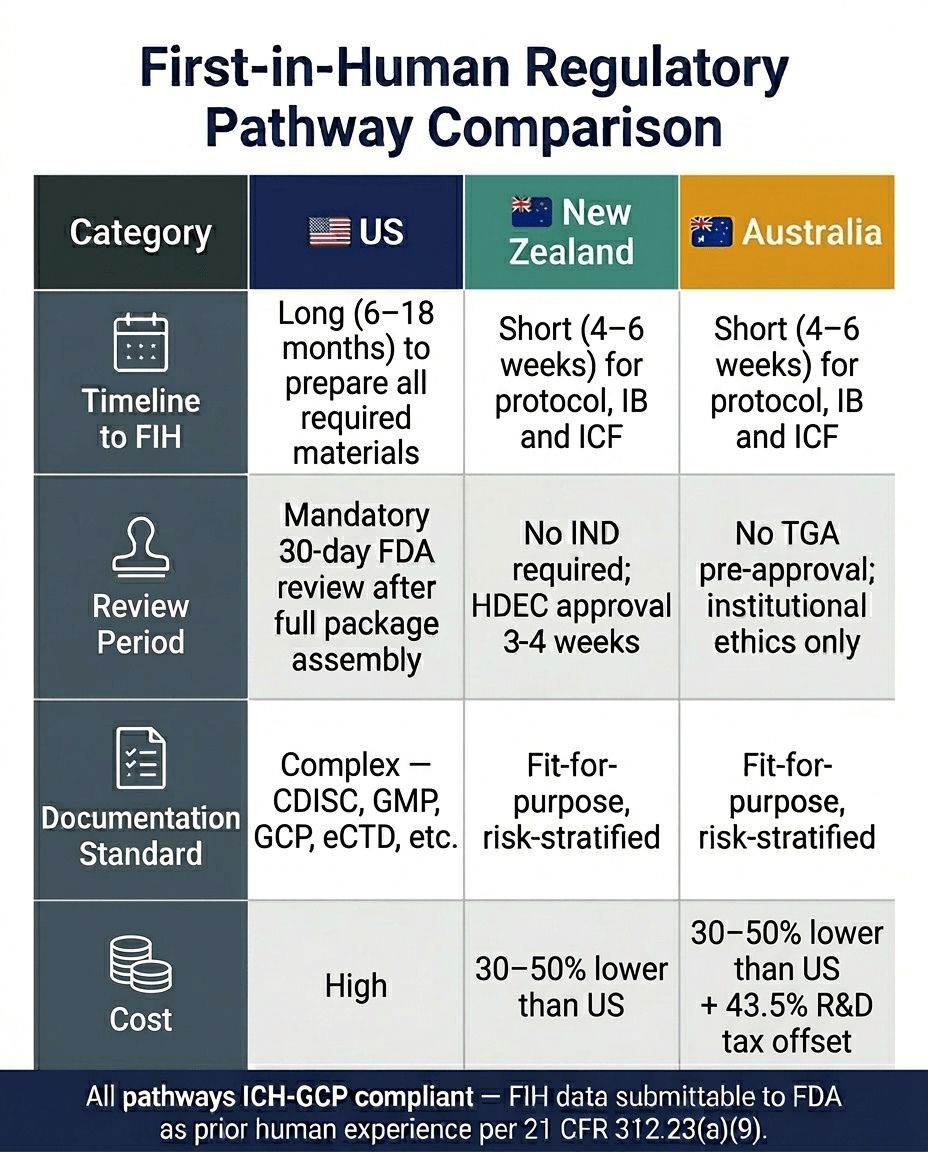
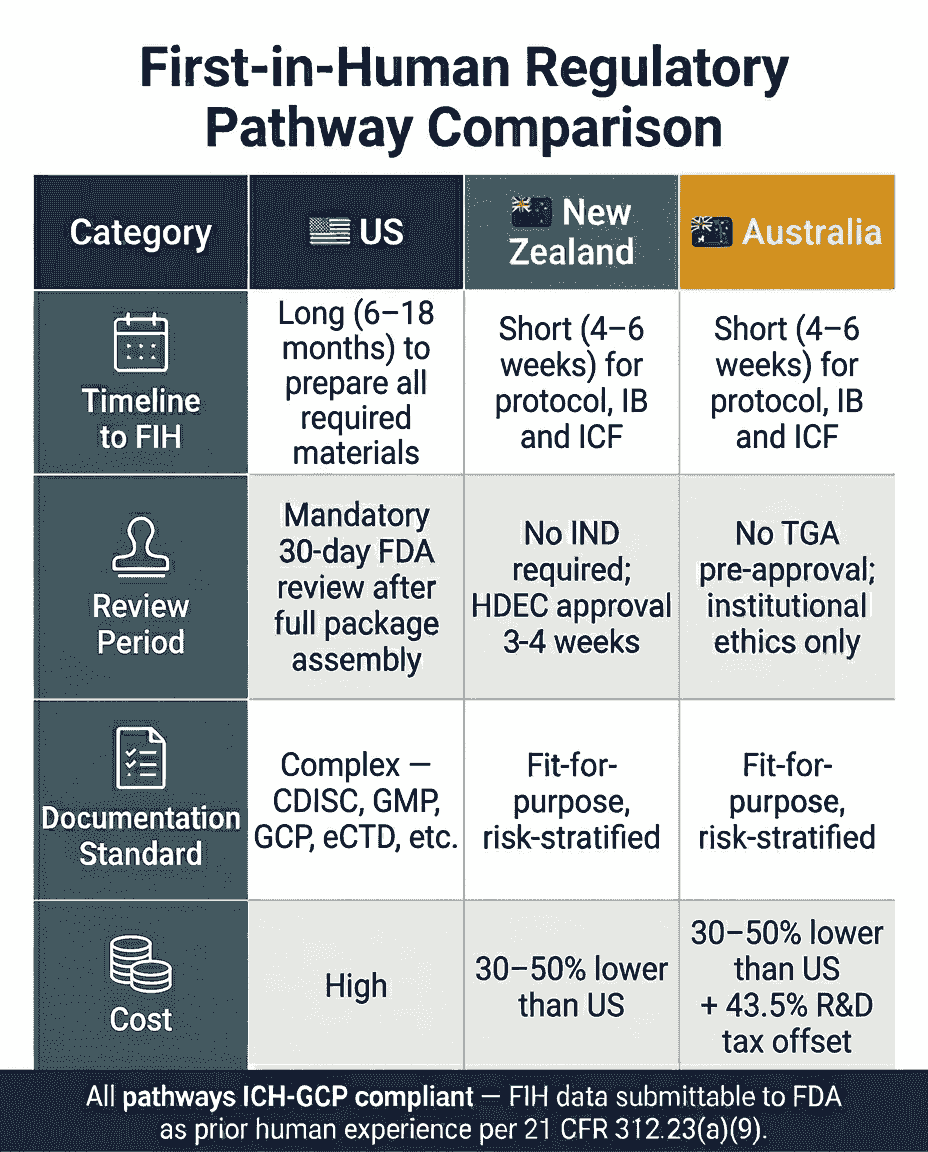
IND submission complexity has grown substantially - particularly for cell and gene therapies, RNA-based platforms, and assets with novel mechanisms of action. The administrative and technical burden alone is formidable: CDISC/SEND data standards for nonclinical data, eCTD-compliant publishing, full data tabulation line listings for every toxicology study, GLP compliance declarations, CMC specifications packages, and an IB built to ICH E6 standards.
FDA’s 30-day review clock does not start until sponsors assemble that entire package, and that preparation alone routinely takes 6-12 months.
New Zealand and Australia take a different approach to the first-in-human trial: fit-for-purpose documentation calibrated to the molecule’s risk profile and study design, not a uniform structural standard. For programs operating under capital and timeline constraints, that difference is material.
One question worth raising early: does your FIH study need to start in the U.S.?
New Zealand
Sponsors submit simultaneously to Medsafe (scientific/regulatory) and the Health and Disability Ethics Committee (HDEC) - no IND equivalent required. HDEC approvals typically arrive in 3-4 weeks; the statutory maximum is 45 days. FIH guidelines align with the EMA’s EMEA/CHMP/SWP/28367/07 risk stratification framework, anchoring safety at the clinical site: mandatory inpatient monitoring, ALS-trained staff, and experienced Phase 1 investigators. Site costs run 30-50% below U.S. or European Phase 1 units. ICH-GCP compliant data qualifies as prior human experience under 21 CFR 312.23(a)(9) for a subsequent U.S. IND.
Consideration: best suited for small molecules and well-characterized biologics in healthy volunteers. Evaluate population variability where appropriate.
Australia
The Clinical Trial Notification (CTN) scheme requires no TGA pre-approval for most Phase 1 studies - institutional ethics approval suffices. Timelines are comparable to New Zealand. A 43.5% refundable R&D tax offset on eligible expenditures materially reduces net trial cost for qualifying sponsors.
Consideration: the tax incentive requires specific entity structuring - engage legal and tax advisors early. Pre-study regulatory dialogue is limited by design; experienced local operational support is essential.
The strategic logic
Sponsors who run early studies outside the U.S. are not bypassing the FDA. They are sequencing their regulatory strategy to reach the IND review with a stronger, human-data-supported package. Global pathway selection is a program-level strategic decision, and it deserves the same rigor as any other element of the development plan.
ECD Life Sciences builds integrated development plans that weigh pathway selection alongside CMC, nonclinical, and clinical strategy. Contact us to discuss where your first-in-human study should start.